
The African Meeting House: the room on Beacon Hill where Black Boston organized a different freedom story
Tucked off Joy Street on Beacon Hill, the African Meeting House is one of Boston’s most consequential historic rooms: a church, school, civic hall, abolitionist forum, and recruiting site tied to the 54th Massachusetts. Its story explains how Black Bostonians made the city’s freedom narrative larger, harder, and more complete.
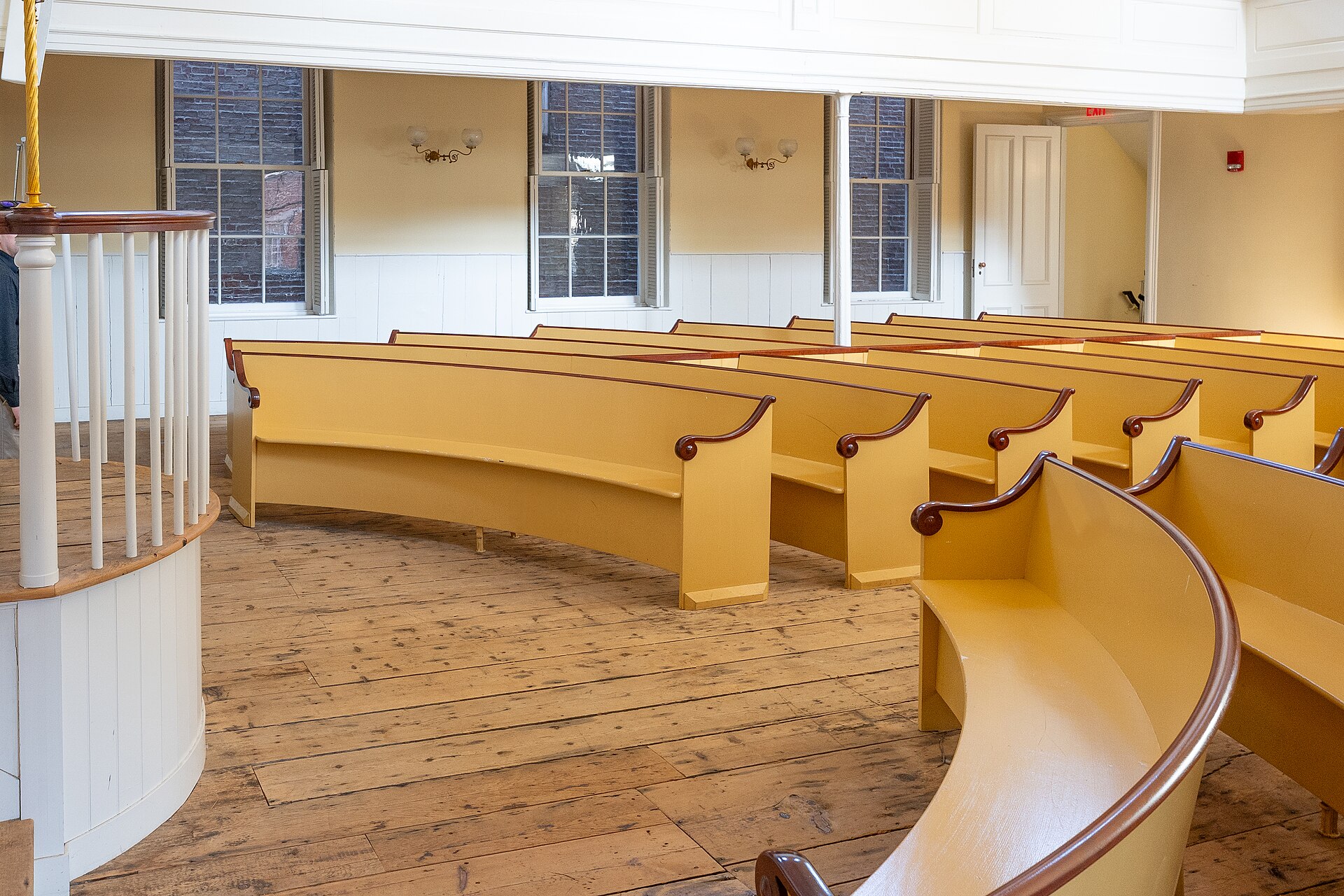
Boston has no shortage of famous historic interiors, but one of the city’s most important rooms is easy to miss. Up a short court on Beacon Hill, the African Meeting House carries a history that is more useful than ornamental: it shows how Black Bostonians built institutions for themselves, used them to fight exclusion, and turned a small neighborhood building into a center of national consequence.
Built in 1806 by Boston’s free Black community, the African Meeting House was originally home to the African Baptist Church. The building is widely recognized as the oldest extant Black church building in the United States. That fact alone would make it significant. What makes it essential is everything else that happened inside it.
For much of the 19th century, this was not simply a church. It was a schoolroom, lecture hall, organizing space, political forum, and community anchor for Black Beacon Hill. The nearby Abiel Smith School, opened in 1835, later became part of that same local history of education and protest. Together, these sites make clear that Beacon Hill was not only a place of elite rowhouses and postcard streets. On its north slope, it was also the heart of Black civic life in Boston.
More than a church
The African Meeting House stood at the center of a self-organized community at a time when Black Bostonians faced exclusion from many of the city’s institutions. The congregation was formally constituted in 1805, and fundraising for the new building followed quickly. Contemporary accounts and later preservation records credit Black Bostonians, including Cato Gardner, with raising substantial funds and providing much of the labor needed to complete it.
From 1808, the first floor housed the African School, where Black children were educated before the opening of the Abiel Smith School. That educational role matters because Boston’s school story is often told as if reform happened from above. Here, the record is sharper: Black families organized, taught, withdrew their children in protest when necessary, and pushed the city toward a fairer system. In 1849, many parents removed their children from the segregated Smith School, and classes returned to the Meeting House as part of the campaign against school segregation.
That makes the building more than a preserved landmark. It is physical evidence that Boston’s long argument over equal education was fought not just in courts and statehouses, but in neighborhood rooms maintained by ordinary residents.
The abolitionist Boston that visitors often miss
If your mental map of historic Boston runs mainly from Faneuil Hall Marketplace to Old North Church, the African Meeting House expands the story in necessary ways. The Revolution is only part of Boston’s freedom history. By the 1830s and 1840s, this building had become one of the city’s key sites for antislavery organizing and public debate.
Abolitionists including William Lloyd Garrison, Frederick Douglass, Maria Stewart, Sarah Grimke, and Wendell Phillips are all documented as having spoken at the Meeting House. The Massachusetts General Colored Association met here. In 1832, Garrison founded the New England Anti-Slavery Society here. The building was also used by the New England Freedom Association, which aided freedom seekers escaping slavery.
Those facts shift the scale of the place. This was not a side site to the better-known Freedom Trail landmarks. It was one of the rooms where Black Bostonians and their allies built organized resistance to slavery and discrimination. If Faneuil Hall Marketplace symbolizes one public tradition in Boston, the African Meeting House represents another: a more contested, more democratic civic tradition created by people who were denied equal standing and made institutions anyway.
- Religious center for Boston’s African Baptist congregation
- School space for Black children beginning in 1808
- Meeting place for abolitionist groups and lectures
- Community venue for celebrations, commemorations, and civic action
- A Civil War-era recruiting site connected to the 54th Massachusetts
The 54th Massachusetts connection
One reason the African Meeting House remains especially relevant now is that it ties together several Boston stories people often encounter separately: abolition, education, Beacon Hill, and the Civil War. In 1863, the building served as a recruitment site for the 54th Massachusetts Volunteer Regiment, one of the first African American regiments to fight for the Union.
That link helps explain why the neighborhood around the State House still carries such historical weight. The Robert Gould Shaw and 54th Regiment Memorial on the edge of Boston Common is a major public monument. The African Meeting House is one of the interior spaces that gives the memorial context. One commemorates sacrifice in bronze; the other preserves the community world that made enlistment, leadership, and political commitment possible in the first place.
Seen that way, the Meeting House is not just a stop on a heritage route. It is one of the places that makes Boston Common read differently. The city’s central landscape of protest, ceremony, and public memory is only fully legible once you include Black Boston’s institutions on Beacon Hill.
A building with layered lives
Like many old Boston structures, the African Meeting House did not remain under one use forever. In 1898, the original Baptist congregation sold the building after the Black population center had shifted increasingly toward the South End. In the early 20th century it became a synagogue, reflecting the neighborhood changes that reshaped Beacon Hill over time. The Museum of African American History acquired the building in 1972, and it is now preserved and interpreted as part of Boston African American National Historic Site.
That sequence matters because it prevents the building from being flattened into a single-era monument. The Meeting House tells several Boston stories at once: Black institution-building, abolitionist politics, migration within the city, Jewish immigrant history, and preservation itself. It is a small structure with an unusually large civic footprint.
Why this story is useful now
The African Meeting House is evergreen because it answers a live question: where, exactly, did Black Bostonians make freedom real in a city that celebrates freedom constantly? The answer is not abstract. It happened in specific rooms, on specific streets, through organized local effort.
That is why this site belongs in any serious understanding of Boston history. It complicates the tidy tourist version of the city without requiring guesswork or myth. It is also one of the clearest places to understand Beacon Hill as more than a beautiful backdrop. Before it was a luxury address, this part of the neighborhood was a center of Black activism, worship, education, and mutual aid.
For locals, the lesson is practical: some of Boston’s most important history sits just off the standard path, within walking distance of headline landmarks but telling a different story. For visitors, it is a corrective. If you only see the city through Revolutionary sites, you miss the 19th-century struggle that gave Boston another claim on the word liberty.
And for anyone building a day around historic Boston, the African Meeting House pairs naturally with nearby Beacon Hill streets, Boston Common, and the larger network of Black heritage sites interpreted in the area. It also belongs in the same mental category as the most meaningful local landmarks: not just places to admire, but places that still sharpen how you read the city.